


The major indexes did not fully show what happened beneath the market on Wednesday.
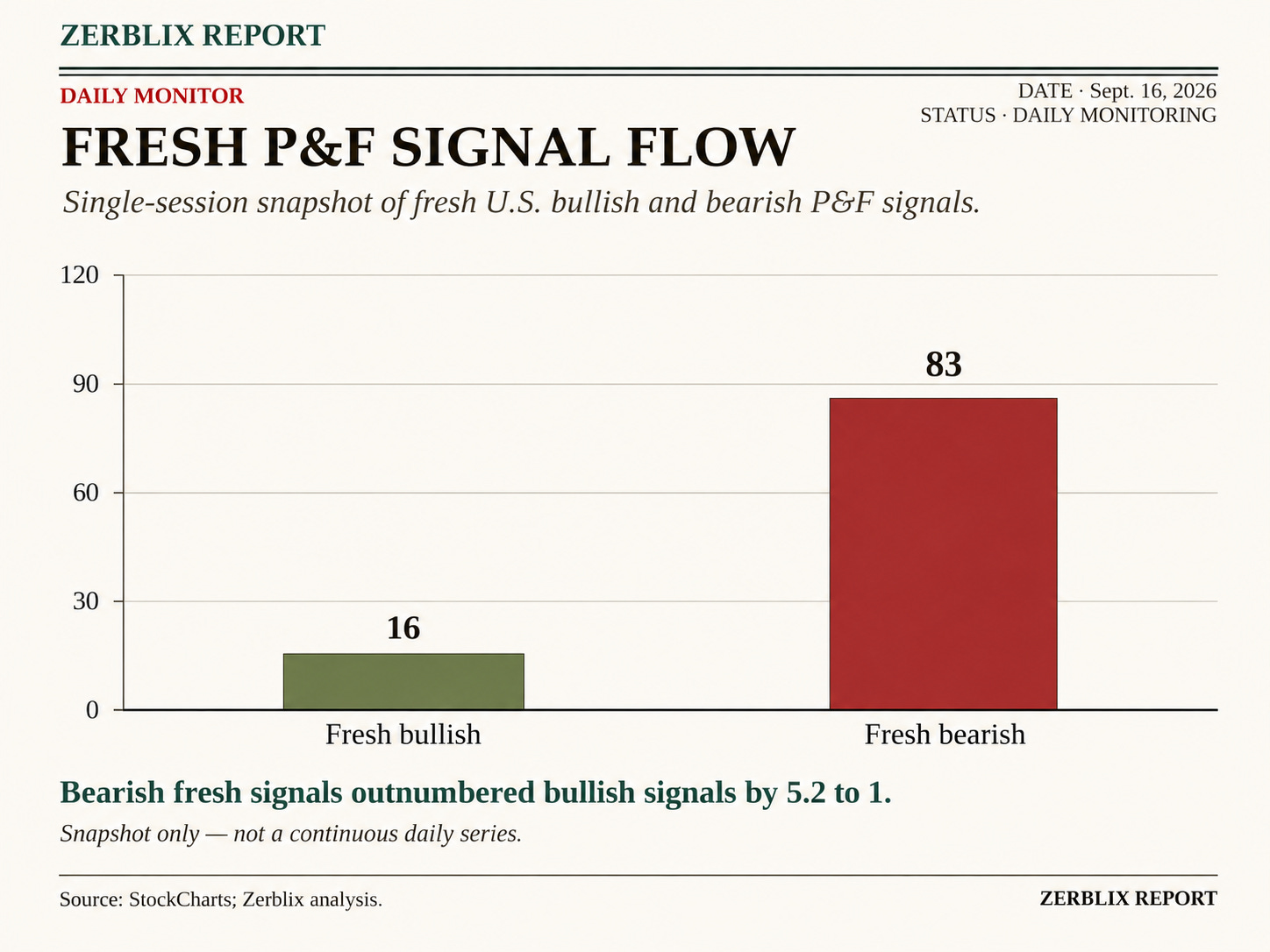
Fresh Point & Figure signal flow leaned sharply bearish on Sept. 16. Zerblix recorded 83 fresh bearish signals versus 16 fresh bullish signals, a ratio of about 5.2 to 1. This should be read as a single-session snapshot rather than a continuous trend from earlier in the month. The next test is whether that supply pressure carries into Friday’s official weekly review.
Pattern Pressure gives back the early-week repair
The fresh-signal deterioration did not occur by itself.
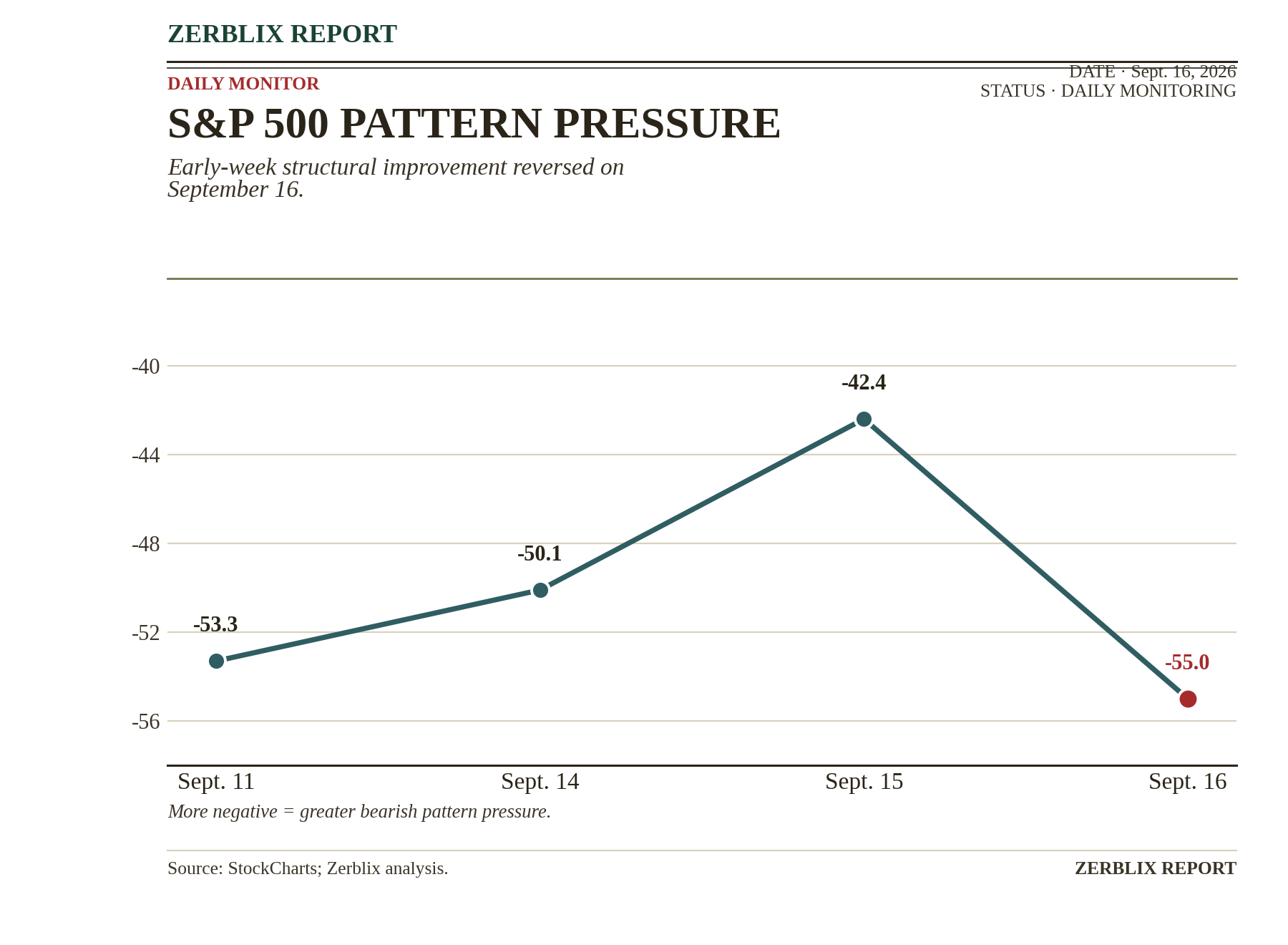
S&P 500 Pattern Pressure improved from −53.27 last Friday to −42.39 on Tuesday, suggesting that the balance between established bullish and bearish P&F structures had become somewhat less negative.
That improvement reversed Wednesday.
Pattern Pressure dropped to approximately −54.96, moving slightly below last Friday’s reading. In other words, the early-week repair did not hold.
That sequence matters.
The structure first showed less pressure. It then failed to produce follow-through. Wednesday brought renewed supply instead.
Participation weakened with the structure
Bullish Percentage (BPI) confirmed the deterioration from another direction.
The S&P 500 Bullish Percent Index fell another 2.40 percentage points to 38.80. That means fewer than four out of ten S&P 500 stocks currently carry P&F buy signals.
Several sectors are considerably weaker.
Consumer Discretionary finished at 20.83, Industrials at 22.78, and Utilities at 25.81. All three are below the lower 30 reference area.
Technology held at 43.66, while Energy remained the strongest sector reading at 71.43. But Energy’s strength came with an important warning: its BPI fell 14.29 percentage points in one session.
That suggests leadership is narrowing even where the absolute breadth reading remains strong.
The index tape looked calmer than the internals
Wednesday also brought an important macro event.
The Federal Reserve raised the federal funds target range by one-quarter percentage point to 3.75%–4.00%, saying economic activity remained solid while inflation was still elevated.
The market reaction was negative but hardly uniform. The Dow fell about 1.2%, the S&P 500 declined roughly 0.4%, while the Nasdaq was nearly unchanged. Declining stocks nevertheless outnumbered advancing stocks.
That contrast is useful.
A nearly flat Nasdaq can make the session appear relatively quiet from the index level. Zerblix breadth and P&F evidence showed something different underneath: fewer stocks were carrying bullish structures, and fresh downside signals expanded sharply.
That is why internal participation matters.
Weak breadth is not the same as financial stress
There is also a counterargument to the bearish breadth evidence.
The latest available St. Louis Fed Financial Stress Index observation, dated September 11 and released today, is −0.8477. A reading below zero represents financial stress below its historical average.
So far, the deterioration appears concentrated in equity participation and P&F structure, rather than in a broad breakdown across the financial system.
That distinction keeps Wednesday’s evidence in perspective.
Supply is expanding.
Participation is weakening.
But the evidence does not yet describe panic.
What matters next
Friday is the important test.
If the new downside signals persist, Pattern Pressure remains deeply negative and Bullish Percentage continues to weaken, Wednesday’s deterioration will have gained structural follow-through.
If fresh bullish signals begin to recover and breadth stabilizes, Wednesday may instead prove to have been another temporary burst of supply.
For now, the Zerblix reading is:
The early-week repair failed. Fresh supply re-expanded, S&P 500 participation weakened with it, and several sectors are already operating from depressed breadth levels. The warning is meaningful—but Friday must determine whether it becomes persistent.