


Monday’s market evidence showed supply expanding quickly.
Tuesday looked different.
New U.S. Point & Figure downside signals fell sharply, confirmed ETF leadership broadened, and Canada shifted toward demand. But the improvement was selective. Nasdaq 100 breadth continued to deteriorate, while Financials, Utilities and parts of Industrials remained weak.
The message is not that the market repaired.
It is that the rate of deterioration slowed while leadership became more selective.
The first change: fewer new breakdowns
New P&F signals show where stocks are newly breaking above prior resistance or below prior support.
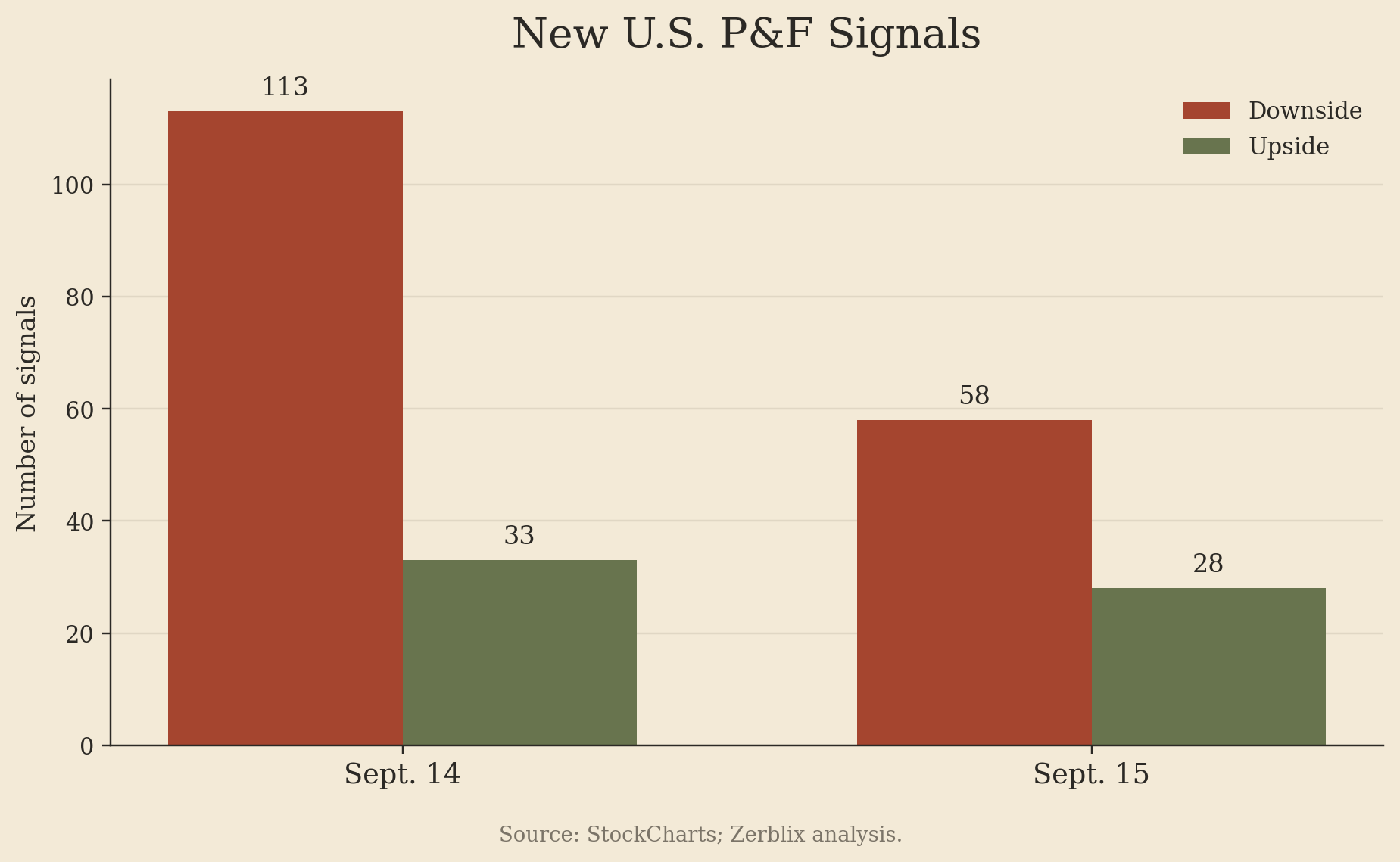
On Monday, the U.S. produced 113 new downside signals against 33 upside signals.
On Tuesday, the count fell to 58 core downside signals against 28 upside signals.
That is still a supply-heavy balance, but the gap narrowed considerably.
Monday looked like supply was spreading.
Tuesday showed that supply was still present, but no longer expanding at the same pace.
That is an important difference.
Canada changed more sharply
Canada showed an even clearer shift.
Monday produced 15 new downside signals against only 3 upside signals.
Tuesday produced 2 downside and 4 upside.
That moves the short-term signal flow from a clear supply imbalance to a modest demand advantage.
Energy remained represented on the upside side, while Monday’s large concentration of Materials and precious-metals breakdowns did not repeat at the same rate.
This does not erase the bearish patterns already in place. It does show that new supply stopped expanding in the same way.
Leadership broadened
The ETF scans added another piece to the story.
Confirmed core leaders increased from 9 to 16, while confirmed weakness declined from 13 to 11.
The strongest leadership remained concentrated in oil, Energy and broad commodities.
USO, XOP, BNO, DBO, FCG, FTXN, FXN and IXC all remained part of the Energy leadership cluster. Broad commodity exposure also appeared through DBC, GSG, COMT and PDBC.
That matters because demand was not appearing in just one isolated vehicle.It was showing across several related areas.
Cybersecurity also appeared as a selective Technology exception through BUG.
Nasdaq breadth remains under pressure
The Nasdaq 100 tells a different story.
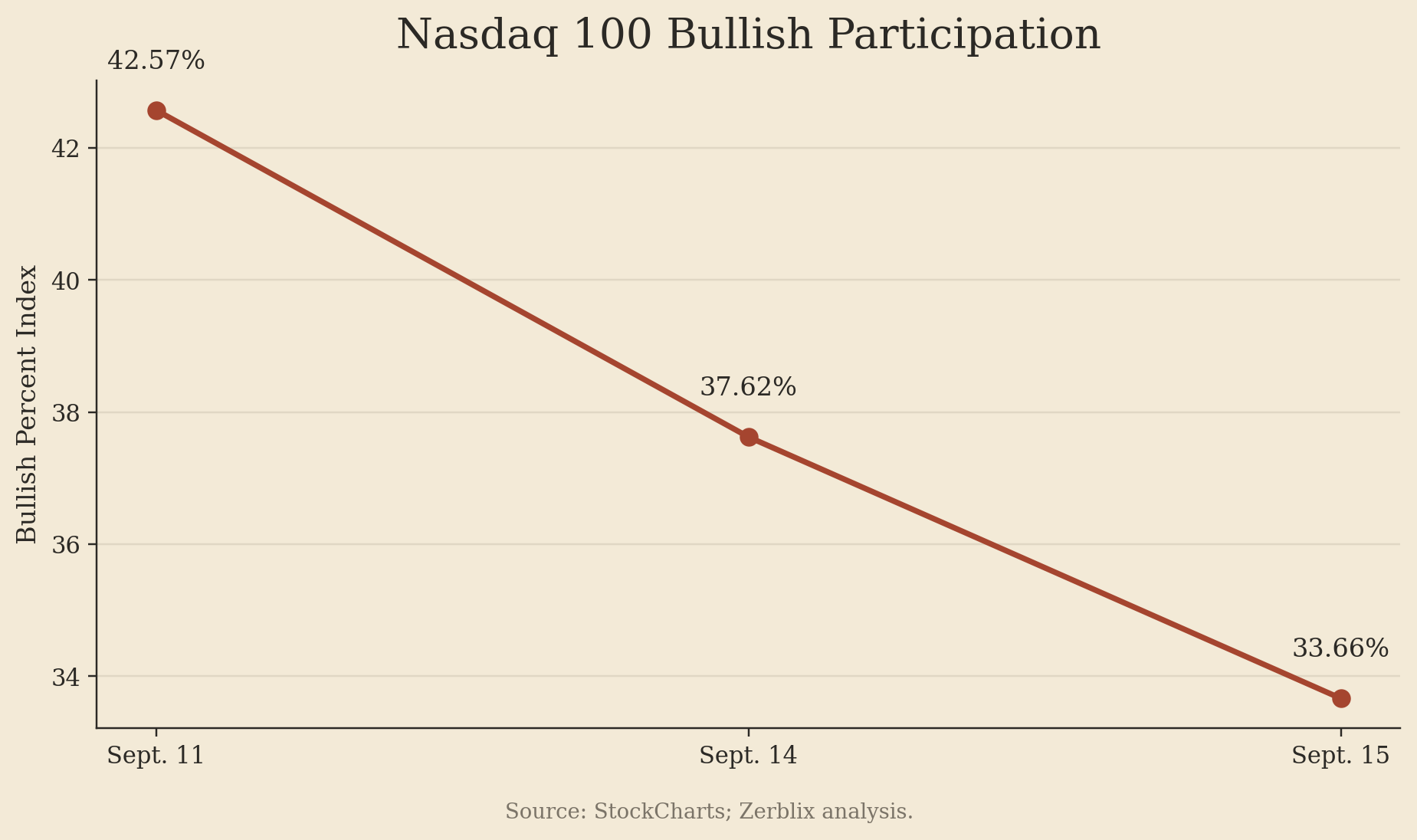
Its Bullish Percent Index moved from:
42.57% on Sept. 11
37.62% on Sept. 14
33.66% on Sept. 15
That is continued deterioration in the percentage of Nasdaq 100 stocks carrying P&F buy signals.
At the same time, broader Information Technology breadth improved slightly, and Tuesday’s new Technology signals moved much closer to balance.
That separation is important.It suggests that Technology is no longer weakening uniformly, even though participation inside the Nasdaq 100 remains under pressure.
Weakness is still visible
Several areas have not repaired.
Utilities remain weak. Financial breadth deteriorated. The broader Industrial sector is still soft, even though the narrower Dow Industrials improved.
Aerospace and defense also remained represented among confirmed ETF weakness.
So Tuesday did not produce broad participation.
It produced better internal balance in some areas and continued pressure in others.
What changed structurally
The strongest part of Tuesday’s evidence is not that demand suddenly became dominant. It did not.
The more important development is that Monday’s expansion in supply lost momentum.
-New downside signals contracted.
-Leadership broadened.
-Canada shifted toward demand.
-Health Care improved.
-Energy and commodities continued to lead.
At the same time, Nasdaq 100 breadth remained weak and several defensive or cyclical areas continued to lag. That combination points to rotation and internal separation, not broad repair.
What would strengthen the read
For this improvement to become more meaningful, Zerblix would want to see follow-through.
That would include continued contraction in new downside signals, broader participation in leadership, improvement in weak breadth groups, and confirmation from the five-universe Pattern Pressure framework.
If downside signals begin expanding again while leadership contracts, Tuesday’s improvement would look more like a pause than a repair.
Supply remains present, but its rate of expansion slowed. Demand is returning selectively rather than broadly.
That moves the market away from Monday’s clearer supply expansion and toward a more divided structure.
For now, the better description is:
less deterioration, more rotation, but no broad confirmation yet.
Pattern Pressure confirmation remains pending.