


Tuesday’s completed Zerblix scan batch showed a market attempting to improve at the margin while the broader internal structure remained under pressure.
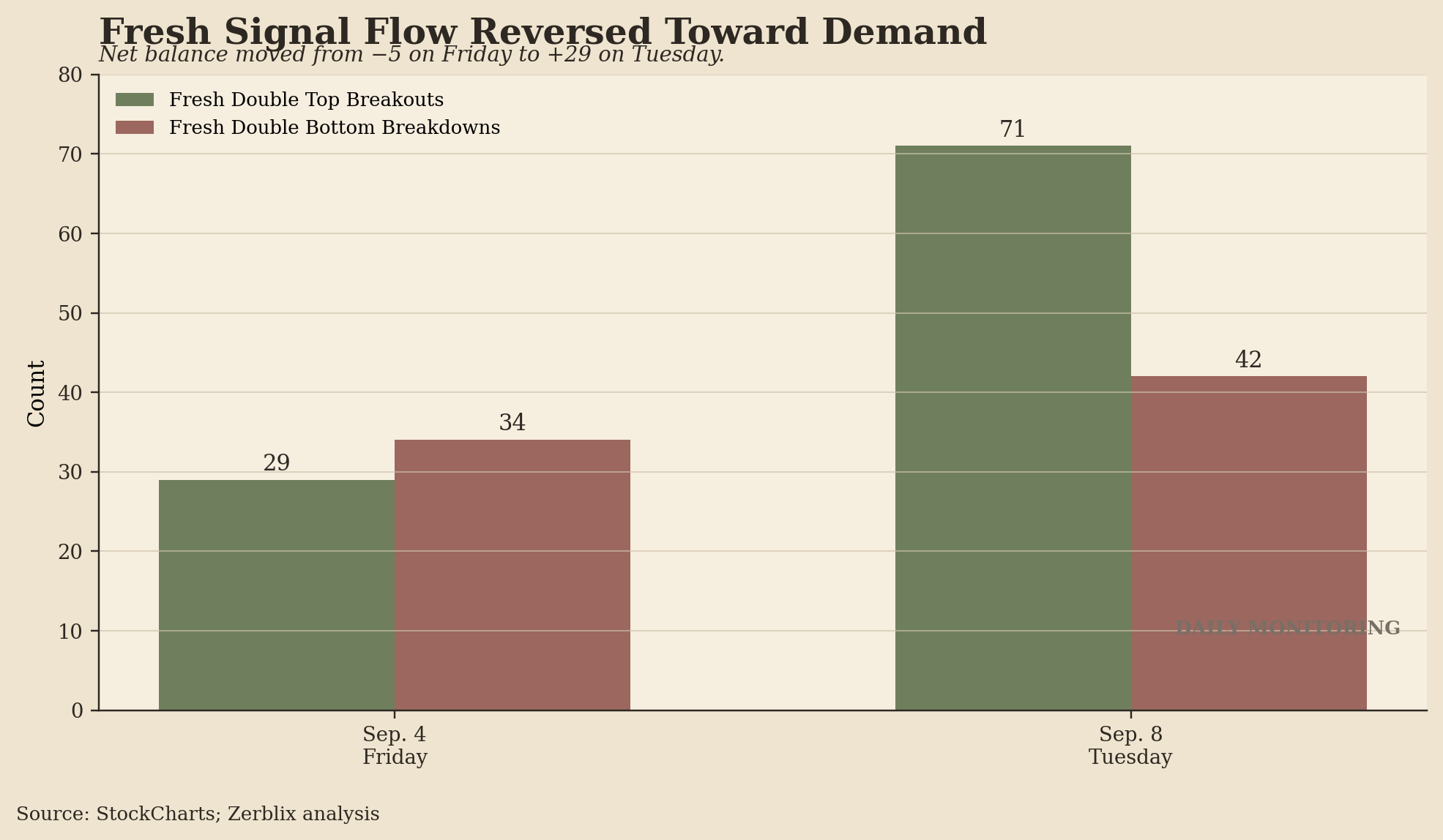
The strongest change came from fresh signal flow. U.S. scans recorded 71 fresh Double Top Breakouts against 42 fresh Double Bottom Breakdowns, producing a +29 net demand advantage. Friday had closed at 29 bullish versus 34 bearish, or −5. New demand therefore expanded sharply on the first post-holiday session.
That improvement did not receive corresponding confirmation from the broader structural measures.
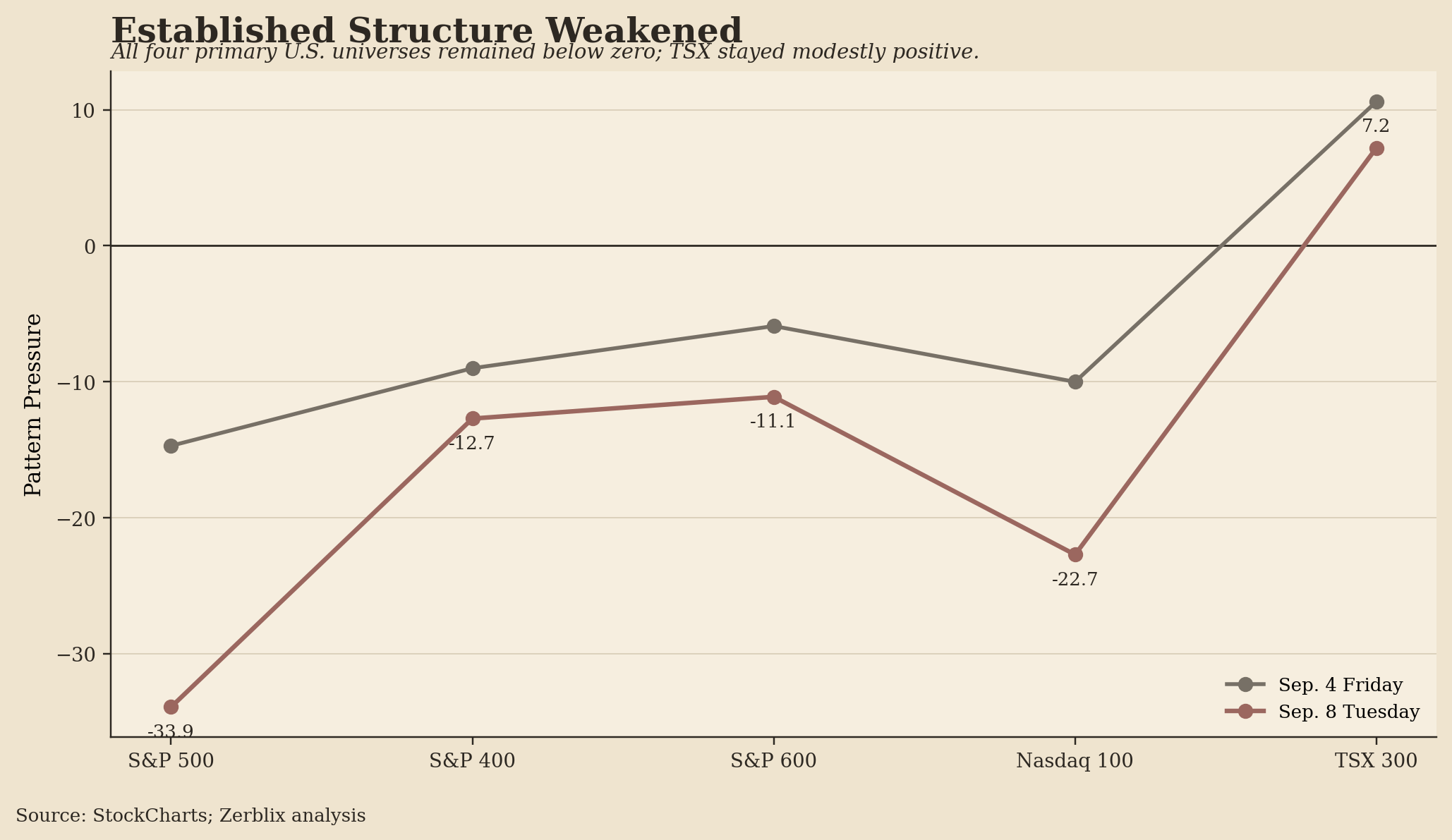
S&P 500 Pattern Pressure weakened from −14.7 on Friday to −33.9 on Tuesday, while the Nasdaq 100 declined from −10.0 to −22.7. The S&P 400 and S&P 600 also deteriorated, leaving all four primary U.S. equity universes in negative Pattern Pressure territory. Friday remains the official weekly benchmark under the Zerblix framework, while Tuesday is treated as Daily Monitoring evidence.
Bullish Percent Indexes showed the same loss of structural support. The S&P 500 BPI fell from 51.8% to 48.2%, moving back below the 50% line. The Nasdaq 100 slipped from 49.51% to 46.53%, the Dow Industrials fell to 50.0%, and the Dow Transports weakened to 35.0%. Across the eight broad-market BPIs, seven deteriorated and only the Nasdaq Composite improved.
The distinction between these measures is important to the interpretation. Fresh signals identify where new demand or supply is appearing now. Pattern Pressure measures the existing balance of selected bullish and bearish P&F structures. Bullish Percent Indexes measure the percentage of the underlying universe already carrying P&F buy signals. Zerblix keeps those measures separate rather than combining them into a single score.
The resulting condition is therefore one of improving marginal demand against still-weak established breadth. Tuesday’s fresh-signal reversal may represent the beginning of a repair attempt, but the broader structure has not yet confirmed it.
Sector breadth remained selective
The average across the ten standard Zerblix sector BPIs declined from 53.58% on Friday to 50.36% on Tuesday, but the deterioration was uneven.
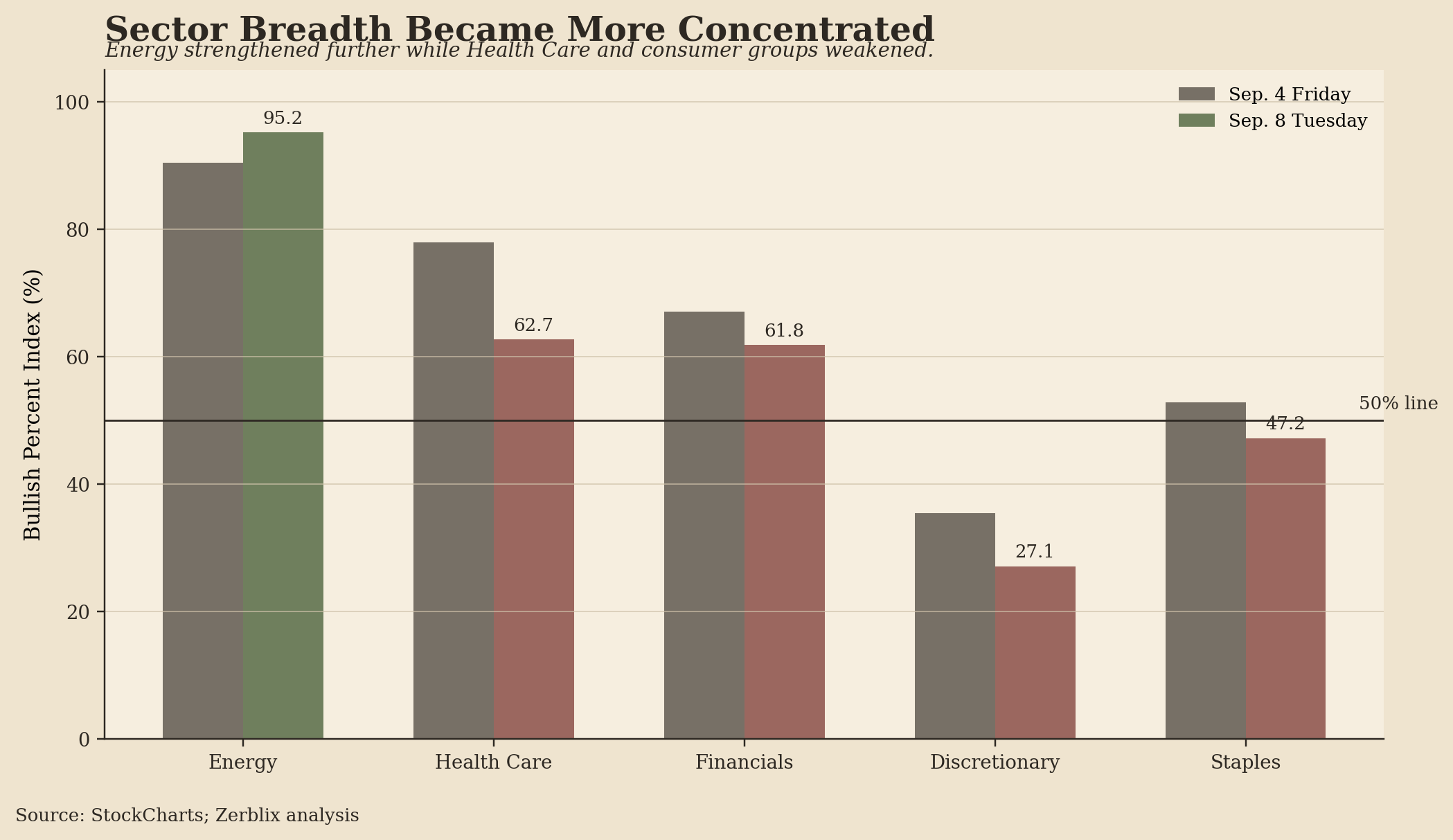
Energy continued to separate positively. Its Bullish Percent Index advanced from 90.48% to 95.24%, while Energy Pattern Pressure remained strongly positive and XLE gained 1.11% on the session.
Health Care moved in the opposite direction. Its BPI fell from 77.97% to 62.71%, Pattern Pressure slipped from positive Friday territory to slightly negative Tuesday, and XLV declined 2.52%. Consumer Discretionary BPI fell to 27.08%, while Consumer Staples moved below 50% to 47.22%.
Technology remained mixed. XLK finished higher, but Technology BPI stayed at only 40.85%, Pattern Pressure remained negative, and both the bullish and bearish fresh-signal scans contained meaningful technology participation. Price strength at the ETF level therefore did not amount to broad constituent confirmation.
Commodities re-emerged as a leadership pocket
The clearest leadership development outside the major equity indexes came from DBC.
DBC appeared simultaneously in the 52-week major leader scan, the 3-month emerging leader scan, and the broader ETF leadership scan. The corresponding major-weakness and emerging-weakness scans both returned zero.
That combination strengthens the case for renewed commodity leadership, but it does not yet establish weekly persistence. DBC also appeared as a developing leader last week and failed to retain that status at the Friday close. Tuesday should therefore be treated as re-emerging multi-horizon leadership under review, not as confirmed weekly leadership.
The broader R01 leadership list showed a similar concentration. Eligible leadership clustered primarily in commodities, Energy, natural resources, and selected international ex-U.S. exposure, while R02 weakness remained comparatively narrow.
Canada did not confirm the U.S. fresh-signal improvement
Canadian fresh-signal flow finished at 3 bullish against 7 bearish, leaving a −4 net supply advantage.
That differed sharply from the U.S. result. Broad TSX Pattern Pressure remained modestly positive, but the fresh-signal layer continued to favor supply, with bearish signals concentrated largely in Technology and Financials.
The U.S. therefore showed a strong improvement in new demand Tuesday, while Canada did not.
Practical interpretation
Tuesday’s scans did not describe a repaired market. They described a market in which new demand improved before established participation did.
The fresh-signal balance shifted sharply toward demand, but Pattern Pressure weakened and broad BPI participation deteriorated. Energy and commodities remained the clearest pockets of strength, while several other sectors continued to show weak or deteriorating internal structure.
The next test is whether Tuesday’s +29 fresh-signal advantage begins to pull Pattern Pressure and Bullish Percent Indexes higher over the next several sessions.
If that occurs, Tuesday may prove to have marked the beginning of a broader repair.
If it does not, the increase in fresh bullish signals will have occurred against a still-fragile structural backdrop.
Friday remains the confirmation point.